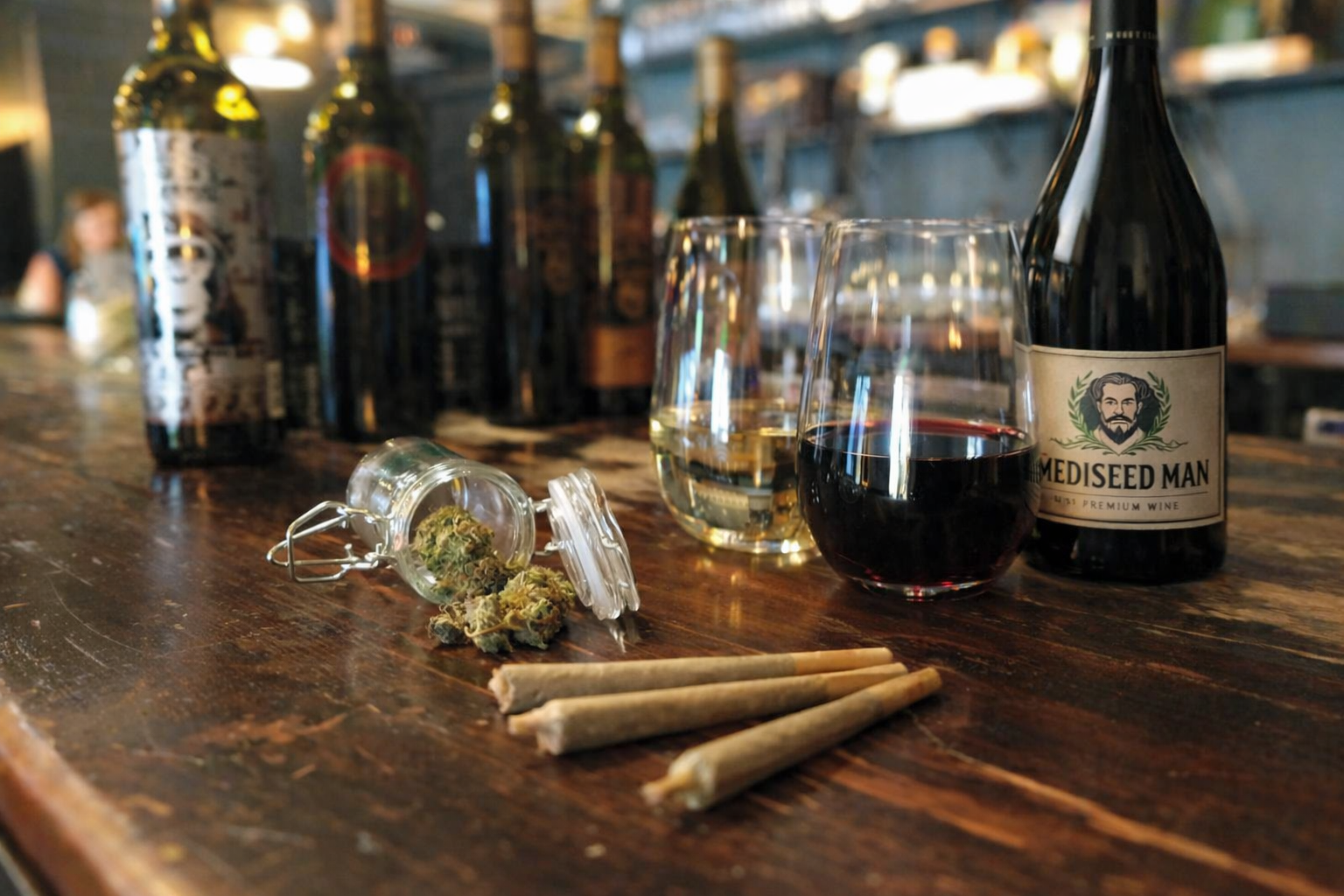
Picture a modern Australian evening: a cork twists from a wine bottle, a jar clicks open. The mood is calm, almost domestic. Cannabis, thoughtfully introduced at home, is gradually shifting from rebellion to routine, much like wine once did.
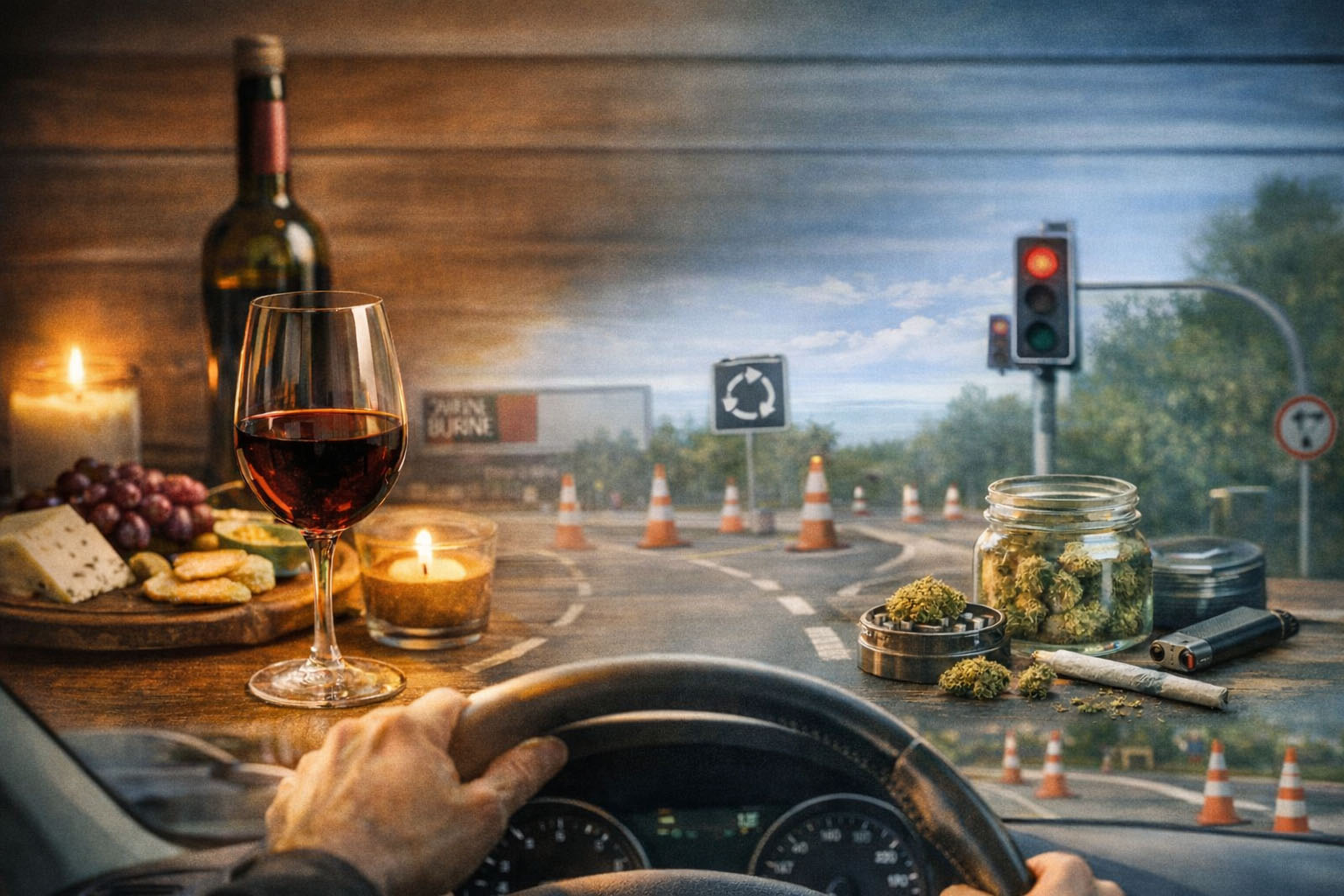
But when it comes to medicinal cannabis driving in Australia, that same quiet routine can collide with a system that treats trace detection as the trigger.
Morning arrives, and the calm is gone.
Anna, 38, takes prescribed THC medicinal cannabis at night for chronic pain. She wakes up clear-headed, drives the kids to school, follows every rule, and still gets waved into a roadside drug test. The saliva test lights up. Under the THC driving laws in Australia, a single positive can matter more than how she actually drove.
This cultural shift is already changing how people talk about cannabis, often using the same language reserved for wine. If you want the sensory side of that comparison, see our wine-and-cannabis sensory analysis.
This gap between what society accepts, what science knows, and what the law enforces gave rise to CAN TRACK, a study seeking common ground.
Wine Culture Meets Cannabis Culture
Australia already understands refinement. In wine, we talk about origin, craft, and care. Cannabis is quietly slipping into the same language. People discuss strains the way they discuss vintages, comparing aroma, intensity, and what makes one batch distinct from the next. The conversation is increasingly about quality and consistency rather than hype.
On the road, cannabis gets none of wine’s accepted frameworks. While wine impairment is measured and messaged, cannabis law still reacts to traces, not proven impairment. That tension sits at the heart of THC driving laws in Australia.
The Trace Problem
This is the core issue in one sentence. Detection tells you THC is present. But detection is simply the act of finding a trace, like smelling smoke hours after a candle has burned out. It does not prove you are impaired right now.
For many patients, this feels like a trap. THC can linger in the body long after the noticeable effects have faded. That creates an enforcement paradox: a person can feel normal, drive carefully, and still be treated as impaired because a test found residue.
Why This Trial Turned Political
This is not just a science story. It is timeline charged.
Advocates have criticised the pace of reform, arguing that delays keep patients stuck under rules that treat presence as guilt. Political pressure has built over time, with leaders framing the issue as a priority while patients continue to face uncertainty.
The trial has become a battleground over what should matter more: protecting patients’ everyday lives or strictly enforcing road safety laws based on THC presence rather than proven risk.
Why a Closed Circuit Track With Roundabouts
The objective is to determine how prescribed THC influences real driving performance by generating evidence across different products. Right now, the evidence base for real-world driving impacts remains limited, which is why this trial is not just worthwhile, but necessary.
The track is designed to feel like everyday driving with traffic lights, intersections, and roundabouts. The point is not a clean loop. The point is decision-making under realistic pressure, where small mistakes can matter.
This trial is not built to settle arguments based on vibes. Its objective is to record measurable driving behaviour in a controlled setting, ensuring the results are repeatable and useful.
Inside CAN TRACK: Drive, Dose, Drive Again
CAN TRACK is built on a clean, logical architecture. Compare each person to their own baseline.
Participants drive on the closed track, take their prescribed medicinal cannabis dose, then drive again. The objective of each trial day is to determine how medicinal cannabis affects driving ability and cognitive performance over time by collecting samples and running cognitive and impairment tests to identify changes and when they occur.
Researchers are not guessing. They examine steering inputs, braking patterns, speed control, lane position, and how well someone handles distractions. A major focus is on lane keeping because it is one of the clearest, measurable signals of control.
This is why CAN TRACK matters for policy. It aims to connect THC presence to actual driving performance rather than assuming the relationship is always direct. For example, imagine a medicinal cannabis patient charged with drug driving after a roadside test detects THC in their system.
With data from CAN TRACK, the patient’s legal team could reference evidence showing that THC presence does not automatically mean impaired driving. If the trial finds that certain detectable levels are not linked to observable impairment, a defence could argue the individual was sober and driving safely at the time. That would move THC driving laws in Australia from a trace-based approach toward one grounded in real driving risk.
Safety, Surveillance, and the Calm Adult Clause
This is not a stunt.
Every drive includes a qualified instructor in a research vehicle with dual pedals, and sessions can be stopped instantly if anything looks unsafe. The entire setup is designed to gather reliable data without putting anyone at risk.
Drivers are monitored heavily on purpose. The design uses GPS, cameras, and monitoring of face, hands, and body position to capture subtle patterns that are hard to see in real time.
Because the biggest risks are not always dramatic. They are microdrifts, overcorrections, inconsistent speed control, and hesitation in complex traffic. These are the kinds of patterns that only become clear once you have enough data.
Why Alcohol Is in the Mix
CAN TRACK does not measure THC in isolation. It uses an alcohol comparator because alcohol impairment is one of the few categories society understands with benchmarks and legal thresholds.
The idea is not to claim THC equals alcohol. The idea is to give policymakers a familiar reference point for interpreting how large any observed change in driving is.
For example, Australia’s standard drink driving limit for fully licensed drivers is a blood alcohol concentration of 0.05 per cent, a clear statutory number most drivers recognise as the legal threshold. Anchoring the comparison this way helps explain why alcohol policy feels measurable, while THC driving laws in Australia still operate more like a presence trigger than a performance test.
Here, the double standard appears: wine is accepted, and alcohol impairment is measurable, but cannabis is reduced to the presence of residue.
The Hard Part: Cannabis Impairment Is Not a Breathalyser Number
One reason this debate never dies is that standardised cannabis impairment testing is still limited. Many existing tests are better at detecting THC than proving real-time impairment.
Researchers have also sought to narrow the time window during which impairment matters most. The emerging consensus is that cannabis can affect driving in the hours immediately after use, but that impairment can fade well before THC stops appearing in the body.
In other words, science and enforcement tools are not perfectly aligned. That is the entire reason a controlled track trial exists.
What Could Change
Other jurisdictions are experimenting with legal defences for prescribed patients. Technology is also circling the problem, with companies developing breath-based tools to detect use in real time rather than relying on leftover traces.
Whether these tools will ever become widely accepted standards remains an open question. But the direction is clear. Policymakers want a way to measure impairment in the moment, not residue from earlier use.
What Happens Next
Recruitment of medicinal cannabis patients has concluded, and recruitment for control participants is expected to begin next. As results get closer, the debate will only get louder. Patients want mobility without jeopardising their licence. Policymakers want evidence strong enough to justify change.
Conclusion: Let Performance, Not Trace, Do the Talking
The cleanest argument for CAN TRACK is the simplest one. Current rules can penalise responsible patients who are not actually impaired, effectively criminalising lawful medical use based on trace presence.
CAN TRACK was built to respond to that. It measures driving performance directly in realistic conditions with the right controls.
For people like Anna, this is not philosophical. It is whether you can manage a health condition and still live a normal life without jeopardising your licence due to residue.
If the data is strong, it gives policymakers something better than a binary. It gives THC driving laws Australia a path toward evidence that speaks the language road safety is supposed to speak: real-world behaviour, measurable risk, and performance behind the wheel.