Broad mites on cannabis can cause serious damage before most growers even realise a problem exists. These microscopic pests attack fresh growth, distort development, and spread quickly when left unchecked. Because broad mites on cannabis often look like nutrient problems. They can also look like heat stress or overwatering. Growers may waste time before finding the real cause.
That confusion is what makes broad mites so frustrating. By the time the damage becomes obvious, the infestation may already be well established.
In many cases, growers first think they have problems.
The good news is that growers can control broad mites if they find them early. They should watch plants closely. They should also follow a consistent treatment plan. If you know what to look for, how they spread, and how to respond, you can better protect your cannabis plants. You can also help prevent another outbreak.
What Are Broad Mites?
Broad mites are tiny plant-feeding pests that target soft, developing growth. They are much smaller than spider mites and far harder to see with the naked eye. Unlike spider mites, broad mites do not leave obvious webbing behind. Instead, they feed on young plant tissue and inject toxins that interfere with normal growth.
As a result, plants begin to twist, curl, blister, and stall. New leaves often emerge misshapen, and tops may stop developing properly. Because broad mites prefer tender tissue, they usually cause the most damage in the newest parts of the plant.
Why Broad Mites On Cannabis Are So Difficult To Spot
Broad mites on cannabis often go unnoticed because their damage looks like several other grow problems. A grower may blame nutrient toxicity, pH imbalance, poor watering habits, excessive heat, or light stress before considering pests.
This overlap in symptoms delays treatment. Instead of checking the newest growth under magnification, many growers spend time changing feed schedules or adjusting the environment. Meanwhile, the infestation keeps spreading.
In some gardens, growers may mix up this problem.
That is why diagnosis matters so much. When strange new growth appears across multiple plants at once, broad mites should be high on the list of possible causes.
How Broad Mites Spread
Broad mites spread through direct contact and contaminated materials. They can move from plant to plant on hands, clothing, tools, pots, fans, nursery stock, and clones. In indoor gardens, they spread quickly once established. Outdoors, nearby plants and general garden movement can also introduce them.
Growers commonly bring broad mites into a grow when they add infected clones or outside plant material. For that reason, quarantine is one of the most important parts of prevention. If you are deciding how to start growing more safely, it is worth reading ” Clones vs Seeds: Growing the best cannabis.
Signs Of Broad Mites On Cannabis
Broad mite damage usually appears first in the newest growth. Watch for these signs:
Twisted Or Distorted Leaves
Fresh leaves may emerge curled, crinkled, cupped, or deformed. In many cases, the damage starts near the top of the plant where new growth is most vulnerable.
Glossy Or Wet-Looking Foliage
Affected leaves can develop an unusual shine, almost as if someone lacquered the surface.
Stunted Growth
Plants may stop stretching, and new shoots may remain small and tightly packed instead of opening normally.
Thick, Brittle, Or Rough Leaves
Damaged leaves can feel tougher, thicker, or more fragile than healthy foliage.
Deformed Tops And Flower Sites
In more severe infestations, growing tips lose vigour and flower development slows or becomes uneven.
Damage That Looks Like Other Problems
Broad mites on cannabis often mimic nutrient toxicity, pH issues, environmental stress, and genetic abnormalities. Some growers confuse these symptoms with other plant issues. These include brown spots on cannabis leaves. They also include causes and treatments for holes in cannabis leaves. Some may confuse them with overwatered or underwatered weed plants.
What Broad Mites Look Like
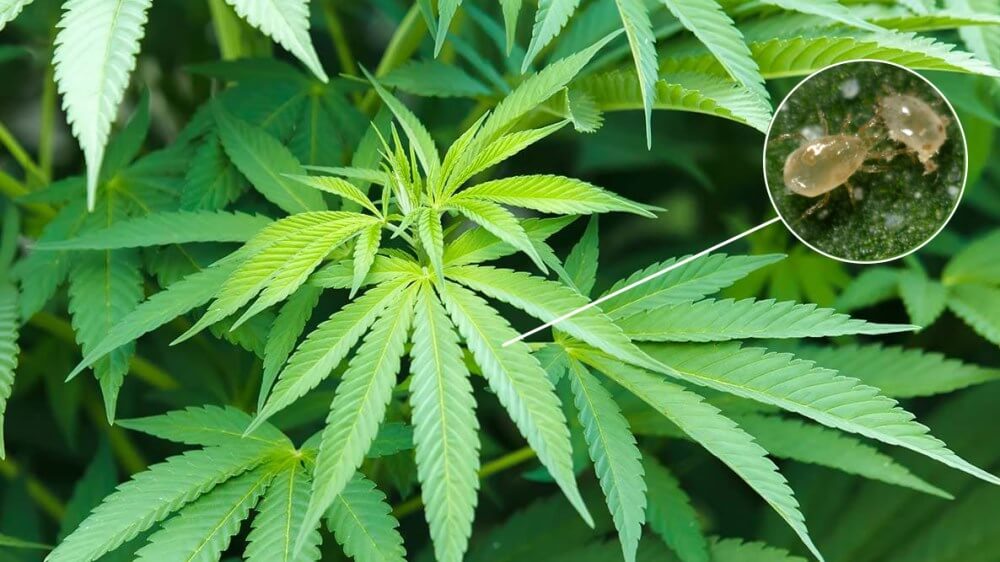
You will usually need a jeweller’s loupe, a pocket microscope, or a digital microscope. Use one to confirm broad mites are present. Adults are tiny, pale, and oval-shaped, which makes them difficult to see clearly without magnification.
Their eggs can help with identification. Broad mites lay eggs on leaf surfaces. Under magnification, the eggs often look translucent. They may have a dotted or textured pattern.
Many growers never see the mites clearly at first. Instead, they recognise the pattern of damaged growth and confirm the infestation by checking affected tops more closely.
Where To Check For Broad Mites
Broad mites prefer soft, actively growing plant tissue. Focus your inspection on:
Older, tougher leaves usually show less activity, so the newest growth is the best place to start.
How To Confirm Broad Mites On Cannabis
The most reliable way to confirm broad mites on cannabis is to inspect damaged new growth under magnification. If the plant shows twisted tops, glossy young leaves, and stalled development, a close inspection can reveal the cause.
Patterns matter too. When several plants show similar deformations at the same time, pests are more likely than a feeding mistake. If you have already ruled out watering, nutrients, and environmental stress, broad mites deserve serious attention.
Can Broad Mites Kill Cannabis Plants?
Broad mites do not usually kill mature cannabis plants overnight, but they can weaken them badly. A severe infestation can reduce growth, lower yield, and leave plants too stressed to recover properly. Seedlings, clones, and young plants face the highest risk because they lack the reserves and structure of mature plants.
Left untreated, broad mites can turn a healthy crop into a poor-performing one. Young growers dealing with weak starts may also find useful crossover advice in fixing cannabis seedling problems.
How To Deal With Broad Mites On Cannabis
The best way to handle broad mites on cannabis is to use a full plan. Do not rely on a single product or a quick spray. Successful control usually includes isolation, pruning, repeat treatment, careful cleaning, and close monitoring.
Step 1: Isolate Affected Plants
Separate suspicious or affected plants as soon as possible. Quick isolation reduces the chance of the infestation moving further through the garden. In a small grow, that may mean removing one plant from the room. In a larger setup, it may mean treating an entire section as contaminated.
Always work with healthy plants first. Handle affected plants last.
Step 2: Remove The Worst-Damaged Growth
Prune badly affected tops, twisted shoots, and heavily damaged leaves where practical. This removes some of the highest-risk tissue and improves access to treatment.
Do not strip a stressed plant too aggressively, but do remove the worst areas that are unlikely to recover. Bag the plant matter immediately and remove it from the grow area. If you need pruning guidance while cleaning up damaged growth, see cannabis pruning: why, when and how.
Step 3: Treat Repeatedly
One treatment rarely solves a broad mite problem. These pests reproduce quickly, and surviving eggs can restart the infestation. A good treatment plan includes repeat applications spaced according to the product and the severity of the outbreak.
Growers often rotate among safe control methods rather than relying on a single product. Whatever method you choose, consistency matters.
Step 4: Clean The Entire Grow Environment
Broad mites do not stay only on the plant. They can move across tools, surfaces, containers, and surrounding equipment, so environmental cleaning is essential.
Pay close attention to:
Good hygiene reduces the chance of reinfestation and supports the rest of your treatment plan. Indoor growers should pay close attention to room conditions and cleanliness. This is key when dealing with issues common in growing cannabis indoors in Australia.
Step 5: Watch New Growth Carefully
Old damage will not suddenly look healthy again. Instead, judge recovery by the quality of new growth. As treatment begins to work, fresh shoots should emerge flatter, healthier, and more vigorous.
If the newest leaves keep twisting or the tops continue to stall, the infestation likely remains active.
Treatment Options For Broad Mites On Cannabis
Treating broad mites on cannabis successfully requires isolation, repeat treatment, and careful cleaning.
Horticultural Oils And Soaps
Many growers use horticultural oils or insecticidal soaps to suppress broad mite populations. These treatments can help, especially during vegetative growth, but coverage must be thorough because broad mites hide in tight growth points and under leaves.
Use them carefully. Heavy application, strong light, or excessive heat can stress cannabis plants further. Late in the flowering stage, most growers avoid these products because residue and trapped moisture can affect bud quality.
Sulphur-Based Treatments
Some growers use sulphur against mite problems, but timing and compatibility matter. Never combine sulphur with oil-based sprays or apply them too close together, because that can severely damage the plant.
Many growers avoid sulphur once flowering starts.
Biological Controls
Predatory mites can help reduce broad mite populations when conditions suit them. Biological controls work best as part of an integrated pest management plan. They work less well as an emergency response to a major outbreak.
They are often most useful for prevention and early suppression. Growers who prefer natural methods can also read Let’s Get Growing Organically. They can also read the best way to grow organic marijuana in Australia.
Heat Treatment
Broad mites are sensitive to high temperatures, so some growers attempt controlled heat treatment. However, heat can also stress cannabis badly when used incorrectly.
For most home growers, direct treatment combined with sanitation is more practical than heating-treating an entire grow space.
Removing Severely Infested Plants
Sometimes removal is the smartest decision. A heavily infested plant can keep the outbreak alive and threaten the rest of the crop. If a plant remains badly stunted, repeatedly deformed, and unresponsive to treatment, starting over may be the better option.
Broad Mites In Vegetative Growth
Growers can usually manage broad mites more easily during veg because there are more treatment options. Bud quality is not yet a concern. If you catch the infestation early, many plants recover well.
That is why routine scouting during veg matters so much. A quick microscope check on suspicious new growth can save an entire room. Understanding overall development helps too. It can help to review the seven stages of weed plant growth, as explained.
Broad Mites In Flowering Cannabis
Once cannabis starts flowering, broad mites become harder to manage. Sprays carry more risk, especially later in bloom. Many treatment options do not suit buds, and trapped moisture or residue can create additional problems.
If broad mites appear early in flower, weigh the severity of the infestation against the safety of any treatment. In late flower, clean control becomes much more difficult. At that stage, growers should closely watch bud health. They should also watch for problems in detecting bud rot & mould on marijuana plants.
How Long Recovery Takes
Recovery depends on how early you catch the infestation and how much damage it caused before treatment began. Mild outbreaks may show improvement within one to two weeks as healthier new growth returns. Severe infestations may take much longer, and some plants never regain full vigour.
Remember that damaged leaves usually stay damaged. Look to the newest growth for signs of real recovery.
Common Mistakes When Dealing With Broad Mites
Waiting Too Long
Because the symptoms look like other problems, growers often waste time adjusting nutrients or settings instead of checking pests.
Relying On One Treatment
Broad mites rarely disappear after a single spray or a single cleaning.
Ignoring The Grow Room
Treating the plant without cleaning the surrounding environment often leads to reinfestation.
Bringing In Unchecked Clones
Many infestations begin when growers skip quarantine and introduce contaminated plant material.
Expecting Damaged Leaves To Recover
Old damage stays visible. Healthy new growth is what matters.
How To Prevent Broad Mites On Cannabis
Preventing broad mites on cannabis is always easier than treating an established infestation.
Quarantine New Plants And Clones
Never move a new clone or outside plant directly into your main grow area. Isolate it first and inspect it carefully.
Inspect Plants Regularly
Check fresh top growth often. Broad mites target the newest tissue, so early inspection gives you the best chance of catching them before they spread.
Keep The Grow Space Clean
Clean tools, trays, surfaces, and hands regularly. Good sanitation reduces pest pressure and lowers the risk of carrying mites from one area to another.
Limit Unnecessary Traffic
Pests travel on clothing, shoes, and equipment. Keep movement between outdoor and indoor spaces to a minimum whenever possible.
Use Integrated Pest Management
The strongest long-term defence combines prevention, monitoring, hygiene, environmental awareness, and targeted treatment. That approach gives growers the best chance of stopping broad mites before they become a major problem. Outdoor growers may also benefit from learning how to protect their outdoor grow and grow cannabis outdoors in Australia.
Broad Mites vs Spider Mites
Growers often compare broad mites with spider mites, but the damage looks different. Spider mites usually create visible stippling and may leave webbing when populations grow. Broad mites, on the other hand, mainly distort new growth and are much harder to see.
If you notice glossy, twisted tops without webbing, broad mites are the more likely culprit. If you have several pest problems indoors or outdoors, this can help. Read how to naturally get rid of thrips, marijuana pests, and fungus gnats.
Are Broad Mites More Common Indoors Or Outdoors?
Broad mites can appear in both indoor and outdoor grows. Indoors, plants grow close together, and conditions stay stable, allowing infestations to spread quickly. Outdoors, nearby plants and surrounding vegetation can reintroduce mites even after treatment.
Indoor growers usually control sanitation more easily. Outdoor growers often face greater reinfestation pressure from the environment.
When To Start Over
Sometimes saving one plant puts the rest of the crop at risk. Removing a plant may be the best move when the infestation is advanced, and nearby plants still look healthy.
Starting over makes sense when:
The plant is still small
Recovery remains slow
New growth stays badly deformed after repeated treatment
The infestation keeps returning
The plant is already in mid to late flower
Final Thoughts On Broad Mites On Cannabis
Broad mites on cannabis are hard to spot. Growers can still control them with fast action and a disciplined approach.The key is early detection. When you check new growth closely, act fast, clean well, and follow treatments, you give plants the best chance to recover.
Do not assume that twisted leaves always indicate nutrients or stress. Sometimes the real problem is a microscopic pest hiding in the newest growth. The sooner you recognise that, the easier it becomes to control broad mites.
FAQ: How To Deal With Broad Mites On Cannabis
What is the first sign of broad mites on cannabis?
The first sign is usually distorted new growth. Young leaves may appear twisted, glossy, tightly curled, or unusually small.
Can I see broad mites without a microscope?
Usually not. Broad mites are extremely small, so most growers need magnification to identify them properly.
Do broad mites stay on older leaves?
They prefer tender new growth. Start by checking the top of the plant and the youngest leaves first.
Can cannabis recover from broad mite damage?
Yes, especially when growers catch the infestation early. Old damage usually stays visible, but healthy new growth can return after proper treatment.
Are broad mites worse than spider mites?
They are often harder to diagnose because they are smaller and their symptoms can mimic those of other plant problems.
Should I throw away a plant with broad mites?
Not always. Mild to moderate infestations can often be managed. However, removal may be the best option when the plant is badly damaged, heavily infested, or deep into flower.
How do broad mites get into a grow?
Growers often introduce them through infected clones, outside plant material, contaminated tools, clothing, or movement between grow areas.
Can I prevent broad mites on cannabis?
Yes. Quarantine new plants, inspect regularly, maintain strong hygiene, and use an integrated pest management approach.